



Academics at Trinity Lutheran School
A Strong Foundation for Lifelong Learning
At Trinity Lutheran School, academic instruction is grounded in God’s Word and supported by clear standards, consistent expectations, and individual attention.
Trinity’s core academic curriculum aligns with the Missouri Learning Standards, while its spiritual curriculum follows Lutheran Religion Standards. Students build the knowledge, responsibility, and academic skills needed for continued growth through high school and beyond.

Curriculum Overview
Trinity provides a well-rounded education that supports students academically, spiritually, socially, and emotionally. The Bible serves as the foundation of the school’s educational approach and is incorporated into daily devotions, religion classes, and instruction across subject areas.
The curriculum emphasizes:

Faith in Daily Learning
Students study God’s Word and learn to apply their faith to their education, relationships, and everyday decisions.

Academic Standards
Core instruction aligns with Missouri Learning Standards and provides a consistent foundation for academic growth.

Literacy
Reading, phonics, language development, comprehension, and written communication are emphasized throughout each stage of learning.

Social and Emotional Growth
Students develop skills such as emotional regulation, empathy, positive relationships, responsible decision-making, and conflict resolution through a Christian perspective.

Service
Students participate in service opportunities that support the school, the surrounding neighborhood, the local community, and broader mission efforts.

Early Childhood
Pre-K–Kindergarten
Trinity’s early childhood program provides a safe and structured environment where students begin building academic, spiritual, and social foundations.
Students are introduced to:
-
Bible stories, prayer, and Christian character
-
Early literacy and phonemic awareness
-
Language development and storytelling
-
Foundational mathematics
-
Sharing, kindness, and emotional regulation
-
Classroom routines and growing independence
These early experiences help students become comfortable in the classroom and prepare them for continued learning.
Elementary School
1st–5th Grade
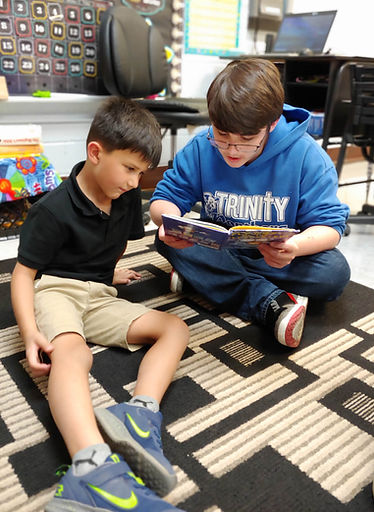
During the elementary years, students move from learning foundational skills to applying those skills across subjects. Reading remains a central priority as students progress from learning to read toward reading to learn.
Students receive instruction in:
-
Religion and Bible studies
-
Language arts and literature
-
Mathematics
-
Science
-
Social studies
-
Art, music, physical education, and technology
Religion instruction includes Old and New Testament studies, an introduction to the catechism, and Christian approaches to relationships and conflict resolution.
Students in grades 1–4 are also introduced to conversational Spanish, including basic vocabulary and cultural appreciation.


Middle School
6th–8th Grade
Trinity’s departmentalized middle school program prepares students for the academic and social transition into high school while strengthening their identity in Christ.
Coursework includes:
-
Advanced Bible study and apologetics
-
Pre-Algebra and Algebra
-
Lab-based science
-
Advanced literature and language arts
-
United States and world history
-
Digital citizenship and responsible technology use
Students continue developing responsibility, organization, leadership, and emotional resilience. Middle school students also take an active role in planning and leading service projects for the school, the surrounding community, and mission efforts.
Subject Areas
Core Subjects and Enrichment
Trinity’s curriculum combines core academic instruction with faith formation, creative expression, technology, language study, and physical development.
Religion and Biblical Studies
Students study Scripture, Lutheran teachings, prayer, Christian character, and the application of faith to daily life.
Literature and Language Arts
Students develop reading, writing, grammar, vocabulary, comprehension, and communication skills.
Mathematics
Students build mathematical understanding through structured instruction, regular practice, logical reasoning, and problem-solving.
Science
Students learn through observation, discussion, experimentation, and inquiry while developing an understanding of God’s creation and responsible stewardship.
History and Social Studies
Students examine historical events, cultures, communities, and primary sources to better understand the world and its development.
Spanish
Students in grades 1–4 are introduced to conversational Spanish, basic vocabulary, and cultural appreciation.
Music
Students in Pre-K through 8th grade participate in vocal music, music theory, liturgical music, and worship leadership.
Band
Students in grades 6–8 develop skills in instrumental performance, ensemble participation, and music reading.
Art
Students in Pre-K through 8th grade explore drawing, painting, sculpture, art history, and other forms of creative expression.
Physical Education
Students in Pre-K through 8th grade develop coordination, physical fitness, gross motor skills, teamwork, and Christian sportsmanship.
Computers and Technology
Students in Pre-K through 8th grade develop skills in digital citizenship, typing, Google Workspace, basic coding, and the responsible use of technology.
.jpg)
Academic Distinctives
What Sets Trinity Apart
Trinity’s academic environment is structured to help students grow in knowledge, responsibility, character, and faith.
1
Christ-Centered Instruction
God’s Word is incorporated into daily school life and provides the foundation for learning, relationships, and decision-making.
2
Small Class Sizes
Smaller classes provide opportunities for individual attention, support, and consistent communication between students and teachers.
3
Clear Expectations
Structured instruction, consistent routines, and accountability help students remain focused and develop responsible academic habits.
4
Skills for Continued Learning
Students develop organization, study, and problem-solving skills that support their work at Trinity and beyond.
5
Measuring Academic Growth
Beginning in kindergarten, Trinity uses NWEA MAP Growth assessments throughout the school year. These assessments help teachers monitor academic progress, identify areas of need, and adjust instruction.